



Healthy is Wealthy
Health Is Wealth: The Hidden Cost of Artificial Sweeteners in a Sugar-Free World
Most mornings, it plays out the same way.
You bring in donuts for your coworkers. A simple gesture. A little joy. A little sugar. But then you hear it:
“I don’t do sweets.”
And yet, minutes later, those same people are pouring packet after packet of artificial sweetener into their coffee. Three. Four. Sometimes more. Every cup. Every day.
So what’s really going on here?
This isn’t about avoiding sugar.
It’s about what our culture has been taught to fear — and what we’ve been quietly trained to accept.
At Mastuhree, we believe health is wealth. And what you put in your body every day is one of the most important investments you’ll ever make.
Let’s break down what long-term artificial sweetener use actually does to your body, how it compares to real sugar, and why “sugar-free” might be costing you far more than you think.
I’ll never reach a point where I value money over my health, because what’s the point of having wealth if your mind and body can’t enjoy it? As you age…
Artificial Sweeteners vs Real Sugar: What Your Body Understands
Sugar — whether it comes from pure cane, raw sugar, honey, or fruit — is a real carbohydrate. Your body has been breaking it down for hundreds of thousands of years.
When you eat sugar:
- Enzymes in your mouth and gut begin digestion
- Glucose enters your bloodstream
- Insulin moves it into cells
- It becomes energy or gets stored for later
It’s not perfect — too much sugar can lead to obesity, insulin resistance, and diabetes — but the process is natural, predictable, and biologically familiar.
Artificial sweeteners are different.
Sucralose. Aspartame. Acesulfame potassium. Saccharin. These are lab-engineered chemicals designed to taste sweet without delivering calories.
Your tongue believes sugar is coming.
Your brain prepares for energy.
Your metabolism reacts.
But nothing arrives.
That mismatch is where the trouble begins.
How Artificial Sweeteners Disrupt Metabolic Health
One of the biggest myths in nutrition is that artificial sweeteners “don’t affect blood sugar.” In reality, sweet taste alone triggers insulin release.
So when you drink sucralose or aspartame:
- Insulin rises
- No glucose enters the bloodstream
- Blood sugar drops
- Hunger increases
This leads to:
- Cravings
- Overeating
- Fat storage
- Energy crashes
It’s one of the reasons people who use artificial sweeteners often struggle with weight, even while trying to cut calories.
Your body keeps waiting for the energy it was promised.
Artificial Sweeteners and the Gut Microbiome
Your gut bacteria play a huge role in:
- Metabolism
- Immune health
- Brain chemistry
- Weight regulation
Studies show that sucralose and aspartame damage beneficial gut bacteria. When your microbiome is disrupted, your body becomes worse at:
- Regulating blood sugar
- Controlling appetite
- Fighting inflammation
- Absorbing nutrients
Sugar, in small amounts, feeds gut bacteria.
Artificial sweeteners poison them.
That’s a massive difference — and one that doesn’t show up on nutrition labels.
Brain Fog, Memory, and Artificial Sweeteners
Aspartame breaks down into three chemicals:
- Phenylalanine
- Aspartic acid
- Methanol
Methanol converts into formaldehyde inside the body — a known neurotoxin.
Long-term exposure has been linked to:
- Headaches
- Brain fog
- Mood swings
- Short-term memory loss
Many people report feeling:
“I can’t focus.”
“I feel off.”
“My mind feels cloudy.”
This isn’t imagined. The brain is highly sensitive to artificial sweeteners, especially when consumed daily.
Do Artificial Sweeteners Cause Cancer?
This question doesn’t come out of nowhere.
Long-term studies show artificial sweeteners:
- Increase oxidative stress
- Promote chronic inflammation
- Disrupt DNA repair
- Alter immune function
The World Health Organization now classifies aspartame as “possibly carcinogenic to humans.”
That doesn’t mean a single packet causes cancer — but chronic daily exposure for years or decades increases risk.
And here’s the part most people don’t realize:
Sucralose heated in hot coffee creates chlorinated byproducts — chemicals known to damage cells.
So when someone loads their morning coffee with artificial sweetener, they’re not just skipping sugar. They’re creating chemical reactions inside their body.
Why Sugar Isn’t Innocent — But Is Still Safer
Let’s be real.
Sugar overuse causes:
- Blood sugar spikes
- Insulin resistance
- Fat storage
- Diabetes
But here’s the key difference:
Sugar is metabolized
Artificial sweeteners are detoxified
Sugar becomes energy.
Artificial sweeteners become chemical waste.
Your liver and kidneys have to work to remove sucralose and aspartame from your body. They were never meant to be there.
One creates fuel.
The other creates stress.
Pure Cane Sugar vs Raw Sugar vs Artificial Sweeteners
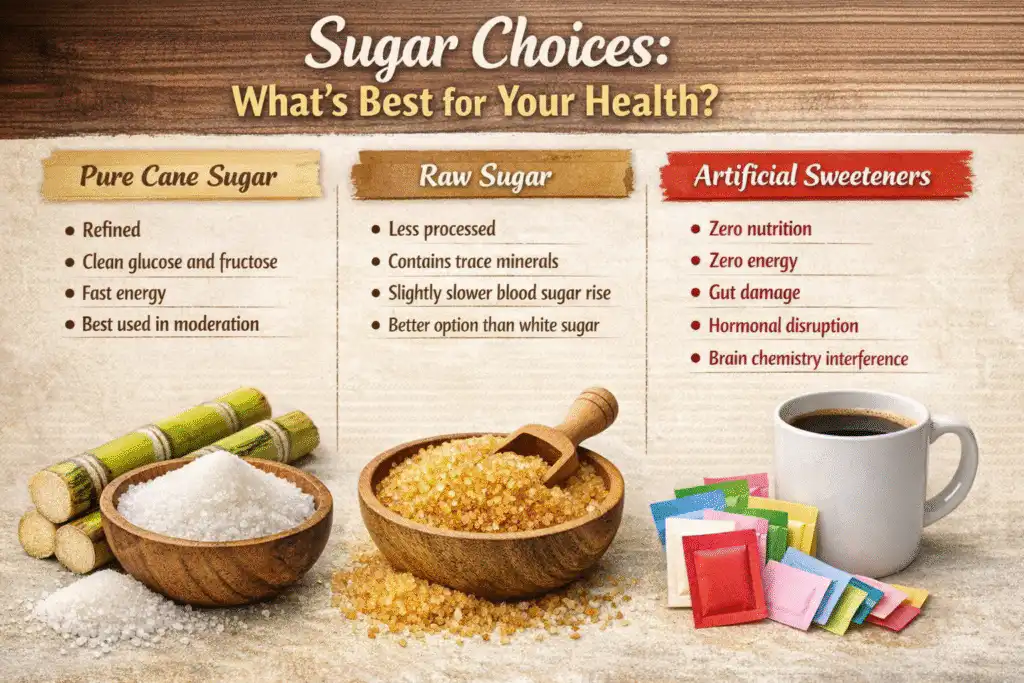
Pure Cane Sugar
- Refined
- Clean glucose and fructose
- Fast energy
- Best used in moderation
Raw Sugar
- Less processed
- Contains trace minerals
- Slightly slower blood sugar rise
- Better option than white sugar
Artificial Sweeteners
- Zero nutrition
- Zero energy
- Gut damage
- Hormonal disruption
- Brain chemistry interference
From a long-term health perspective, artificial sweeteners are the worst option.
Why “I Don’t Do Sweets” Isn’t What It Sounds Like
Skipping a donut but drinking chemical sweeteners isn’t choosing health.
The donut:
- Is real food
- Causes a sugar spike
- Your body recovers
The artificial sweetener:
- Never satisfies
- Never resolves
- Never provides energy
- Creates metabolic confusion
One causes a spike.
The other causes a system-wide disruption.
The Mastuhree Health Is Wealth Truth
Real wealth isn’t about cutting calories.
It’s about protecting:
- Your gut
- Your brain
- Your metabolism
- Your long-term vitality
If you’re going to sweeten:
- Use small amounts of raw sugar
- Or honey
- Or maple syrup
Your body understands those.
It does not understand sucralose.
And the people avoiding donuts while pouring chemicals into their coffee?
They’re not choosing discipline.
They’re choosing a slower, quieter kind of damage.
At Mastuhree, we don’t chase shortcuts — in fashion or in life.
Because health is wealth, and what you build every day shows up in how long — and how well — you get to live.
Connected Articles




Most Popular





More In Healthy is Wealthy

Healthy is Wealthy
Signs and Symptoms of CPTSD

Culture Family Healthy is Wealthy Lifestyle
27 Years On: A Son’s Journey Through Ovarian Cancer — Symptoms, Support & Hope

Healthy is Wealthy
Black Women-Owned Wellness Spots

Healthy is Wealthy
Support Cancer Awareness with Stylish T-shirts – Shop Now!



Healthy is Wealthy
The Importance of Self-Care for Mental Health

Healthy is Wealthy